Deciding which action is more convenient can be difficult in certain situations. Some players follow their hunches and decide on the spot. Others observe certain parameters of the game and factor them into their decision making. Regardless of our methods, how can we be sure that we are making the optimal decision? How can we tell we are choosing the actions that optimize our earnings?
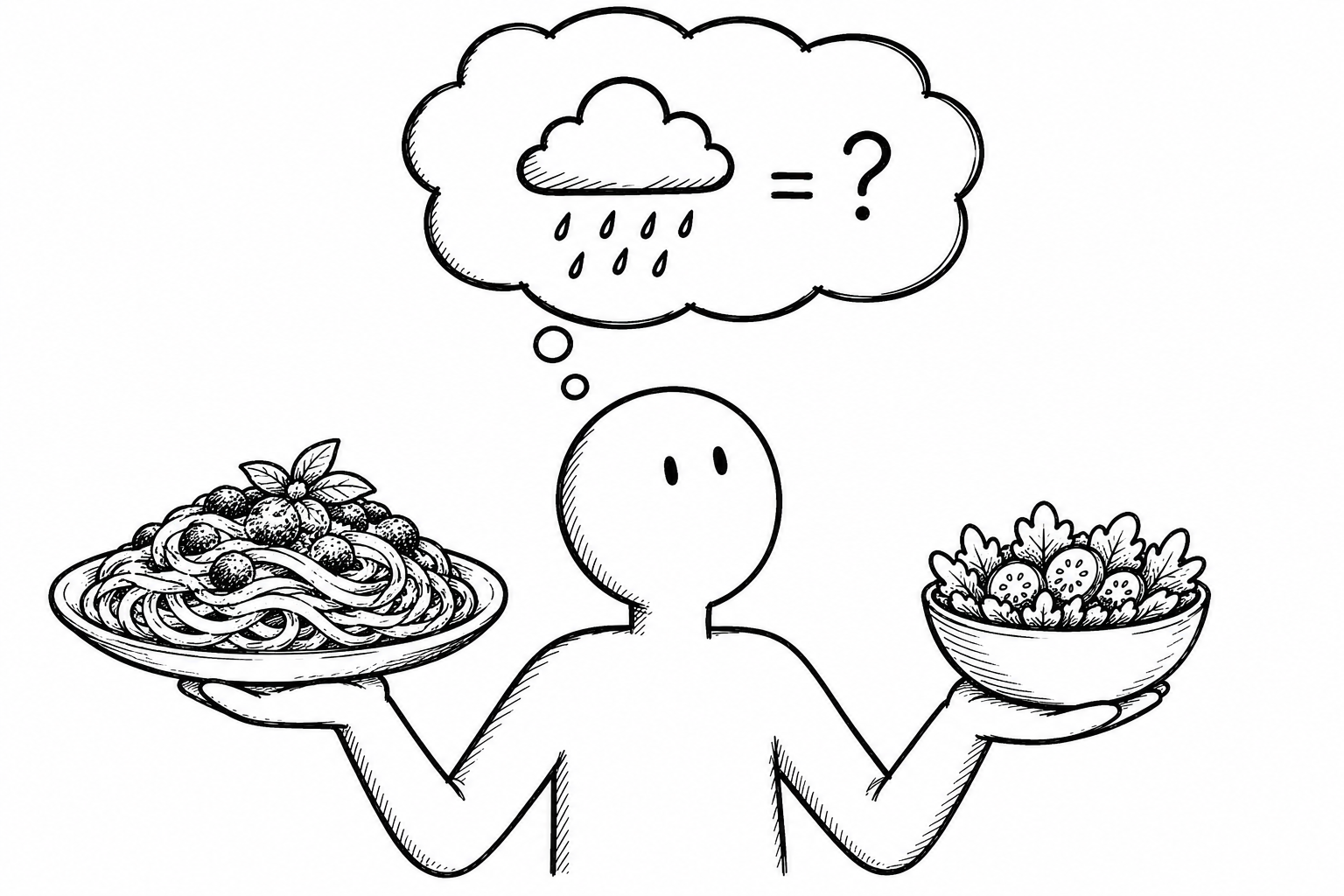
To answer these questions, let's examine the decision making behind a trivial example: choosing a meal option for a lunch out. When we need to decide among several food options, we decide based on a number of factors: the available options in the menu, their price, the time we have, etc. And, above all, we decide based on how hungry we are. The ultimate goal of having lunch is to satisfy our hunger; if we make the right choice, we will have satisfied our hunger at the end of the meal.
This trivial example reflects a few aspects of decision making. Firstly, we make our decisions based on one or more input parameters. When choosing lunch, the main input parameter is our level of hunger. Secondly, we measure the results of our decisions based on one or more output parameters. In the lunch example, the main output parameter is our level of hunger after eating. Finally, we determine whether the decision was correct or not by categorizing the results. If we are satisfied, we have made a good decision. If we are still hungry, we have made a bad decision.
To make good decisions we need to understand the correlation between input and output parameters. The more correlated these two sets of parameters are, the more accurate our decisions can be. In the case of choosing lunch, that correlation is obvious, because we use the same parameter to measure the input and output: our level of hunger. If I were to choose a meal option based on the weather conditions instead, the correlation would disappear. In that case, there would be no certainty I will have satisfied my hunger at the end of the meal.
Decision making in Blackjack is no exception. The goal is to earn money, so good decisions will be the ones that maximize our earnings. An effective way of measuring the expected earnings is the edge indicator we introduced in chapter 3, so that can be our output parameter. To optimize our decision making, we will want to base our strategies on input parameters that correlate well with the edge indicator. If the input parameters don't correlate well with the edge indicator, we can't be certain that the strategy is achieving maximum earnings. That happens to the case for the "Stand on X" strategies.
It might seem the input parameter of the "Stand on X" strategies is the player score, but in fact it is not. The "Stand on X" strategies try to find balance between the risk of busting and the potential of improving the hand score. They pose the question "What is the maximum probability of busting I am willing to accept in order to try improving my score?". The input parameter they focus on is actually the probability of busting for the player score.
When we play, we don't explicitly calculate the probability of busting (i.e. the input parameter) every time we make a decision. That information is not immediately available to us and it takes some effort to calculate. We instead rely on the player score (i.e. some other indicator), which implicitly contains that information. The input parameter at the core of the strategy however is the probability of busting.
Using the independent probability model, introduced in chapter 1, we can express the probability of busting for a certain score as the number of cards out of 13 that make the player bust. Choosing the maximum probability of busting you are willing to accept determines the lowest score you will stand on. If you are willing to accept, say, a 60% risk of busting, it means you will draw up to 16 (53.85% probability of busting) and you will stand from 17 (61.54% probability of busting) onwards.
| Max probability of busting | Strategy | Edge |
|---|---|---|
| 0/13 = 0% | Stand on 12 | -8.08% |
| 4/13 = 30.77% | Stand on 13 | -6.82% |
| 5/13 = 38.46% | Stand on 14 | -5.82% |
| 6/13 = 46.15% | Stand on 15 | -5.28% |
| 7/13 = 53.85% | Stand on 16 | -5.21% |
| 8/13 = 61.54% | Stand on 17 | -5.67% |
| 9/13 = 69.23% | Stand on 18 | -9.00% |
In chapter 3 we computed the edge of several "Stand on X" strategies to find out the X value that maximizes the edge. In general, when we find ourselves having to test different values of an input parameter to find the one that maximizes an output parameter, it often means that we don't understand the correlation between them or that there is no correlation in the first place.
So the probability of busting doesn't help us maximize our earnings. What other input parameters can we use then? Treating soft scores differently? The dealer's probability of busting? Neither of these parameters correlate well with the edge either. To find the parameter we are looking for we need to take a step back and analyze the problem from a different perspective.
The ultimate question we want our strategy to answer is: "Which of the available actions yields the most earnings in the long run?". Since we measure the expected earnings via the edge indicator and that is also our output parameter... why not using the edge as the input parameter of our strategy then? The correlation between the input and output parameters would be as good as it gets.
Using the edge as input parameter comes with a challenge: we need to calculate the edge for each available action for each possible score. Is that feasible? Let's start with the easy bit: the edge of standing. When we stand, we determine the final score of our hand. Having the final score, we can compare it with the expected final scores of the dealer in the same fashion we did in chapter 3. Merging the probabilities of each different comparison gives us the expected edge for standing with that score. The edge of standing with a score of 20, for example, is 57.96%.
| Dealer score | Probability | Outcome | Edge (weighted) |
|---|---|---|---|
| 17 | 14.51% | Win | 14.51% |
| 18 | 13.95% | Win | 13.95% |
| 19 | 13.35% | Win | 13.35% |
| 20 | 18.03% | Push | 0.00% |
| 21 | 7.27% | Lose | -7.27% |
| BJ | 4.73% | Lose | -4.73% |
| 22+ | 28.16% | Win | 28.16% |
| Edge | 57.96% |
Source: https://capelski.github.io/blackjack-stats/en/optimal/analysis/20?a=stand
Now the hard part: the edge of drawing a card. Just like we did with the edge of standing, to determine the edge of drawing a card we need to know the final scores drawing a card will lead to. The challenge is that drawing a card doesn't determine the final score of the hand. If we draw a card with a score of 9 and the card we get is a 5, for example, that makes our score 14. Will we continue to draw? If so, we can't tell the final score without knowing the decision we will make with that score of 14. Our decision is affected by future decisions. Which, in turn, might be affected by further future decisions. That sounds like an infinite loop. Are we in a chicken and egg dilemma?
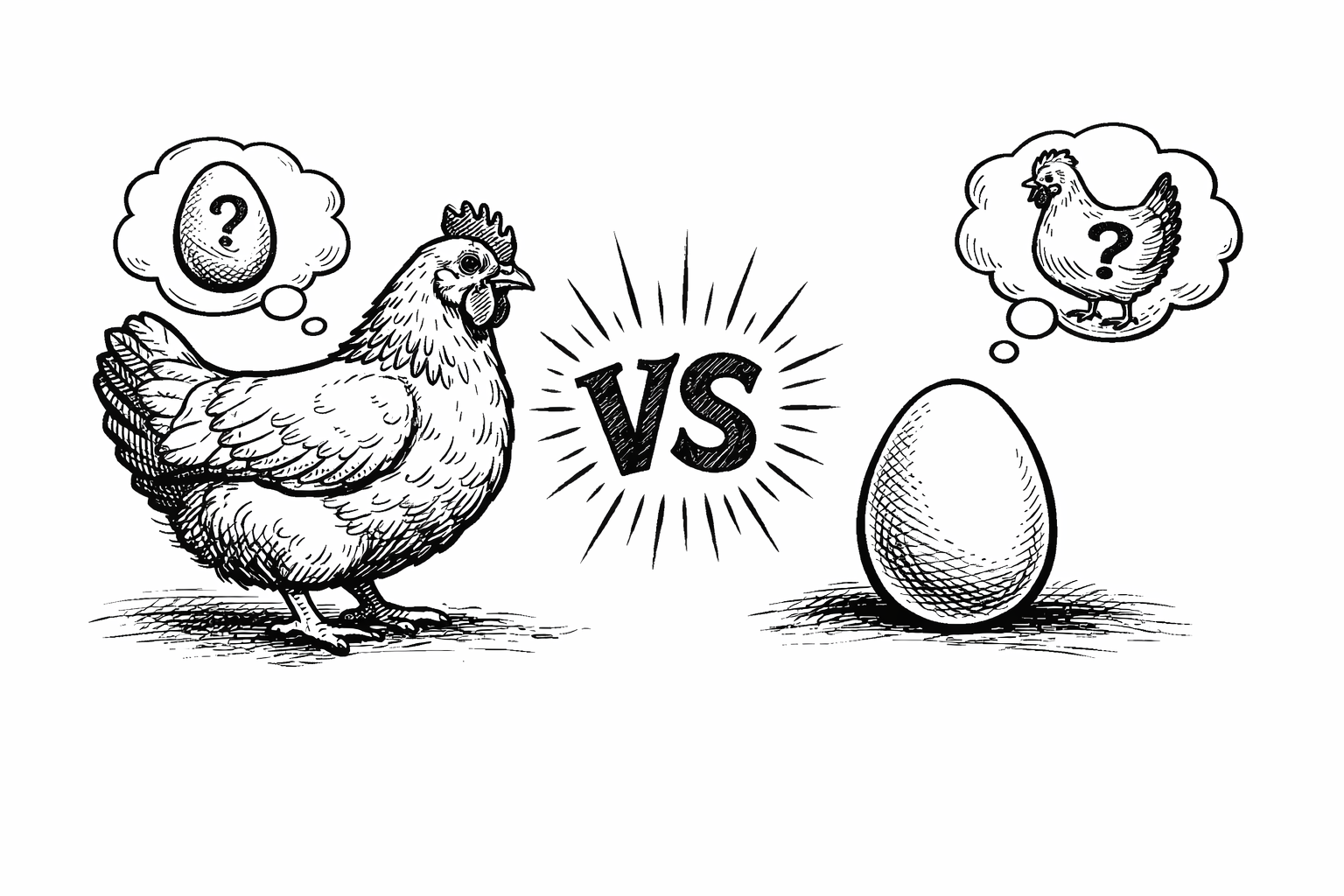
Fortunately, the loop cannot last forever. We will eventually bust or reach 21, and we won't be able to draw more cards. That means that we know all the possible future scenarios of drawing a card with a score of 20. That is enough to calculate the edge of drawing a card with such a score 💪 We do so by multiplying the edge of each future scenario by the probability of reaching that scenario, which is the probability of drawing a card that leads to it. Finally we sum all the values together.
| Next card | Probability | Next score | Action | Edge | Edge (weighted) |
|---|---|---|---|---|---|
| A | 1 / 13 | 21 | Stand | 83.26% | 6.40% |
| 2 - K | 12 / 13 | Bust | End | -100% | -92.31% |
| Edge | -85.90% |
Source: https://capelski.github.io/blackjack-stats/en/optimal/analysis/20?a=hit
We are now able to compare the edge of both actions. That is -85.90% for drawing vs 57.96% for standing. Since it has the highest edge by far, the optimal action is to stand. This will hardly surprise you, since intuitively you already know that drawing a card with a score of 20 is a bad idea. Now we have a mathematical proof of it. Something interesting happens next. By deciding to stand with a score of 20, we have determined all the possible future decisions for drawing a card with a score of 19. We can calculate the edge of drawing a card with a score of 19 🎉
| Next card | Probability | Next score | Action | Edge | Edge (weighted) |
|---|---|---|---|---|---|
| A | 1 / 13 | 20 | Stand | 57.96% | 4.46% |
| 2 | 1 / 13 | 21 | End | 83.26% | 6.40% |
| 3 - K | 11 / 13 | 22+ | Bust | -100.00% | -84.62% |
| Edge | -73.75% |
Source: https://capelski.github.io/blackjack-stats/en/optimal/analysis/19?a=hit
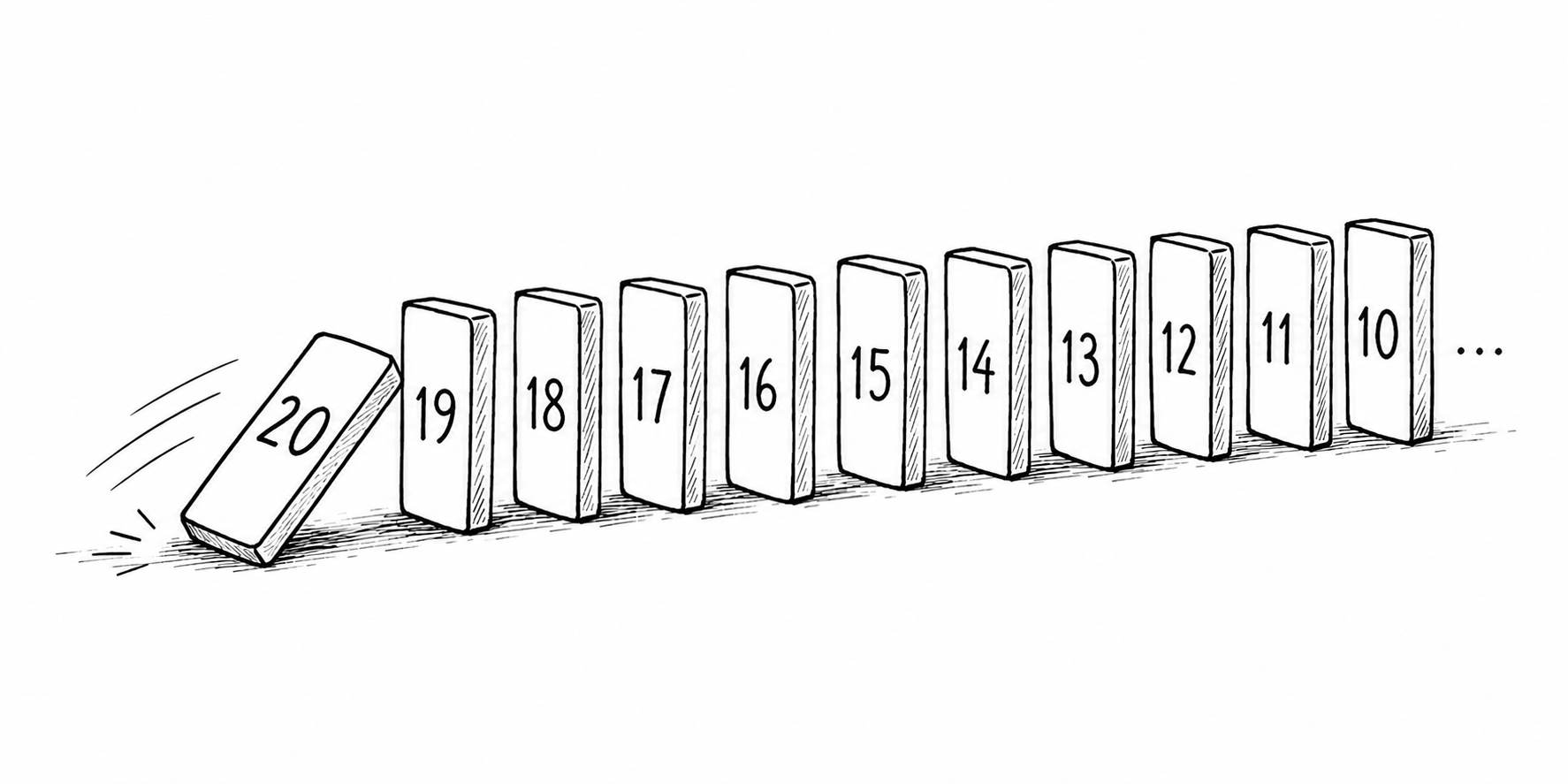
We can now compare that number with the edge of standing with 19 and determine the optimal action for a score of 19. That will in turn determine all the possible future decisions for drawing a card with a score of 18. This triggers a domino effect that allows us to calculate the edge of drawing a card with all possible scores down to the lowest one. In game theory, this is known as backward induction. Here is the list of optimal actions for every possible score.
| Hand | Stand | Hit | Action |
|---|---|---|---|
| 2/12 | -43.68% | -1.12% | Hit |
| ... | ... | ... | ... |
| 7/17 | -29.17% | -11.54% | Hit |
| 8/18 | -0.71% | -4.97% | Stand |
| ... | ... | ... | ... |
| 10/20 | 57.96% | 8.56% | Stand |
| 4 | -43.68% | -22.71% | Hit |
| ... | ... | ... | ... |
| 14 | -43.68% | -42.26% | Hit |
| 15 | -43.68% | -46.60% | Stand |
| ... | ... | ... | ... |
| 20 | 57.96% | -85.90% | Stand |
Source: https://capelski.github.io/blackjack-stats/en/optimal/analysis
We now know the action with the highest edge for every possible situation. By choosing such actions we can be certain our strategy is maximizing our edge and, therefore, maximizing our earnings. Obviously, we won't be computing the edge of every possible action in real time while playing. That would be painful. All we need to do instead is memorize the optimal actions for each player score. Our optimal strategy at this stage can be summarized as "Stand on 15 and 8/18" for easy remembering.
These are bitter sweet news. On one hand, we have an easy-to-remember strategy that we know maximizes our earnings. On the other hand, the strategy is not very profitable. The edge of the "Stand on 15 and 8/18" strategy is -4.07%. Better than the -5.21% edge of the "Stand on 16" strategy, but still not good enough. In the next chapter, we will be looking at how to use the dealer card to improve the edge significantly.
Posts timeline