To make the game more appealing for players, casinos offer additional actions besides standing or drawing a card. Those actions are not always profitable however, and we might end up losing more money than we should if we chose them indiscriminately. In this chapter we will have a look at how doubling in the right situations will help us make more money at the end of the day.
Doubling consist in doubling down the bet size, as the name suggests, and being dealt one more card only. Which ever score we get after getting that card will be the final score of the hand and the dealer will move on to the next player. It is a risky move, as we will not have the chance to keep drawing more cards afterwards. We will only want to double when we have high probabilities of winning the game after being dealt a single card.
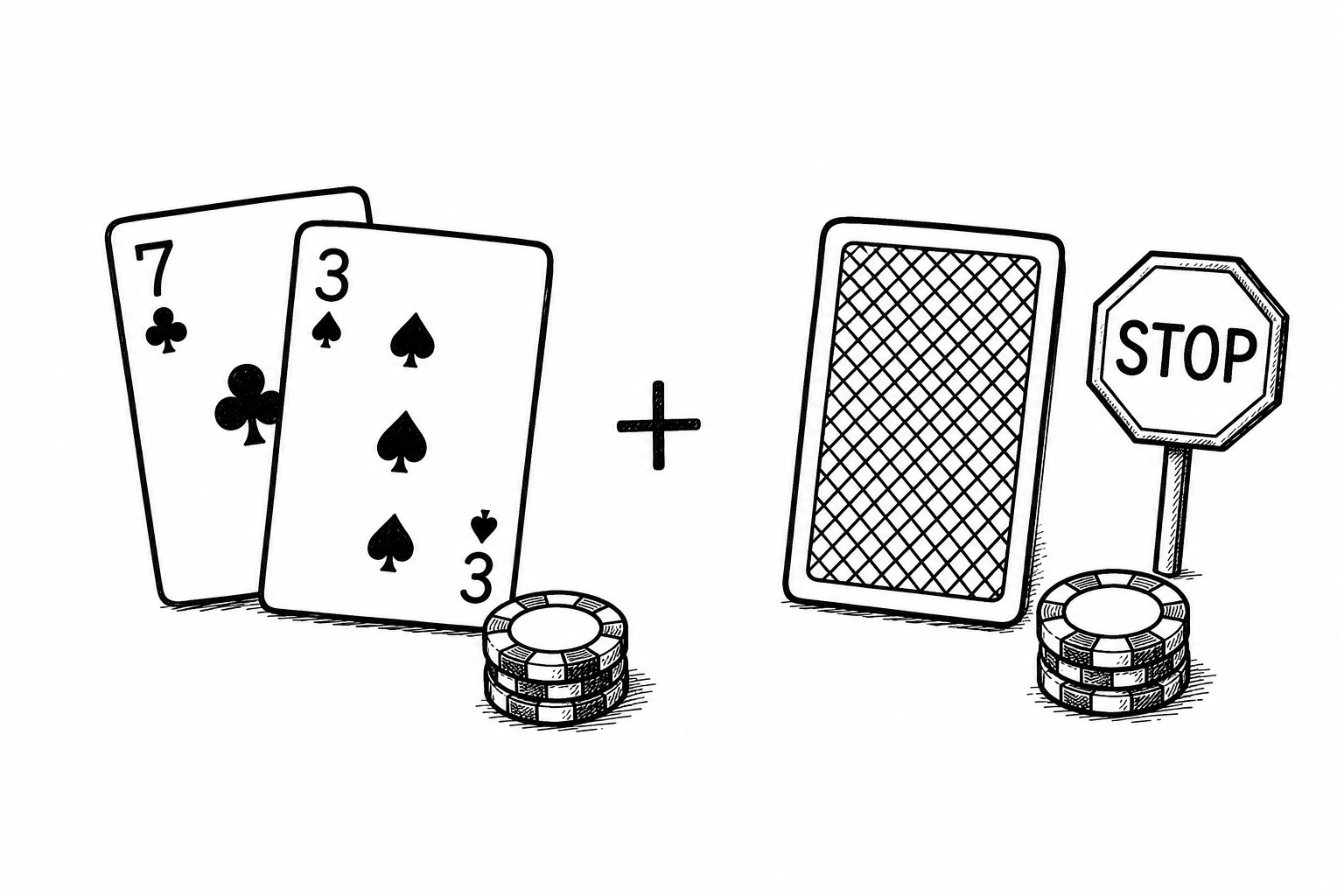
Imagine we double down with a score of 4, for example. Our final score will be 15 if the next card is A, 6 if the next card is 2, 7 if the next card is 3, and so on. The final score of the hand will always be in the 6 - 15 range. Since the dealer final score is always 17 or greater, with such a range of final scores we will only win the game when the dealer busts. At practice, this makes doubling the same as standing for player scores of 4. With the difference that we will lose twice as much money, since we will have doubled the bet. This makes doubling a bad move.
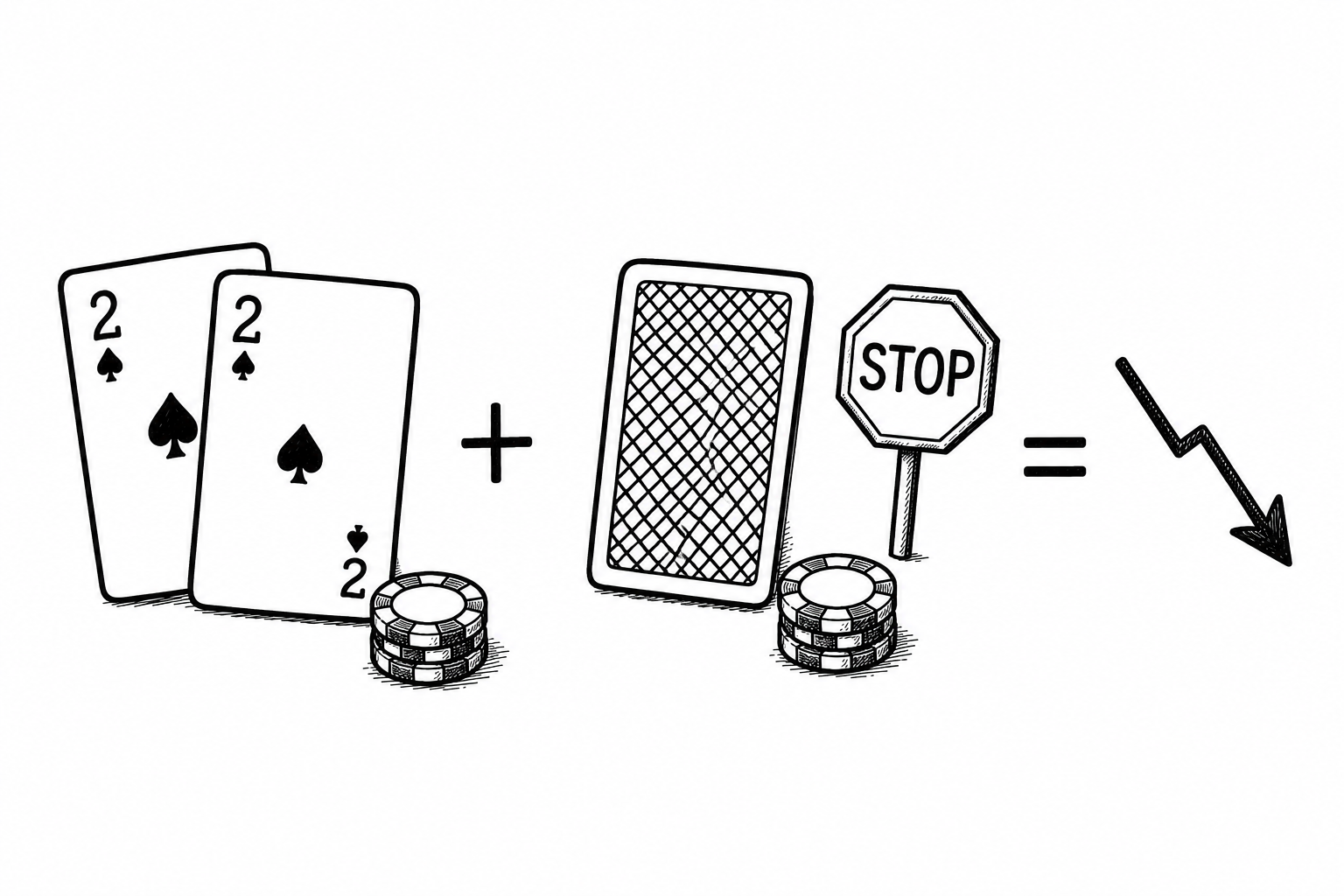
To identify the situations where we can benefit from doubling, we need to compute the edge for doubling in the same fashion we did in chapter 4. Just like the edge of drawing, the edge of doubling comes from combining the edge of all the future scenarios we can get to with the next card. The are two differences though:
- After doubling, we can not draw any more cards. Regardless of what the optimal action is for each future scenario, we will be forced to stand.
- Doubling implies multiplying our bet size by 2. The edge of each future scenario doesn't consider the double bet size so, when we merge them, we obtain the edge for drawing one more card and then standing. Remember the edge of an action expresses the expected earnings in terms of bet size. If the bet size is doubled, so will be the expected earnings. We need to multiply the obtained edge by 2 to account for the doubled bet size.
This is what the edge of doubling looks like for a score of 10.
| Next card | Probability | Next score | Action | Edge | Edge (weighted) |
|---|---|---|---|---|---|
| A | 1 / 13 | 11/21 | End | 83.26% | 6.40% |
| 2 | 1 / 13 | 12 | End | -43.68% | -3.36% |
| 3 | 1 / 13 | 13 | End | -43.68% | -3.36% |
| 4 | 1 / 13 | 14 | End | -43.68% | -3.36% |
| 5 | 1 / 13 | 15 | End | -43.68% | -3.36% |
| 6 | 1 / 13 | 16 | End | -43.68% | -3.36% |
| 7 | 1 / 13 | 17 | End | -29.17% | -2.24% |
| 8 | 1 / 13 | 18 | End | -0.71% | -0.05% |
| 9 | 1 / 13 | 19 | End | 26.59% | 2.05% |
| 10 - K | 4 / 13 | 20 | End | 57.96% | 17.83% |
| Edge | 7.19% x2 = 14.37% |
Source: https://capelski.github.io/blackjack-stats/en/optimal/analysis/10?d=9-to-11&a=double
Now we know how to obtain the edge of doubling. Let's recompute the table of optimal actions for each player score in the same way we did in chapter 4, including the option to double. The table reveals that, overall, doubling is only worth it when the player has either a 10 or an 11. That seems reasonable. After drawing a card with 10 or 11, the optimal action for most future scenarios is to stand; not being able to draw any more cards doesn't penalize us much. And, since 10 and 11 are strong scores to draw a card with, doubling amplifies the earnings even more.
| Hand | Stand | Hit | Double | Action |
|---|---|---|---|---|
| 2/12 | -43.68% | -1.12% | -32.54% | Hit |
| ... | ... | ... | ... | ... |
| 9 | -43.68% | -3.97% | -19.64% | Hit |
| 10 | -43.68% | 8.56% | 14.37% | Double |
| 11 | -43.68% | 14.40% | 26.05% | Double |
| 12 | -43.68% | -33.04% | -67.20% | Hit |
| ... | ... | ... | ... | ... |
| 20 | 57.96% | -85.90% | -171.81% | Stand |
Source: https://capelski.github.io/blackjack-stats/en/optimal/analysis?d=all
How does doubling affect the expected earnings of the strategy? To find the answer, we will need to modify slightly the calculations we did in chapters 2 and 3. In chapter 2, we compiled a list of all the possible hands a player can end up with. Doubling causes some of the hands in that list to end up with a doubled bet size. Hands of 8,2 and 8,3, for example, will double and end up with a 2x bet multiplier. Let's keep track of that.
| Cards | Score | Probability | Bet multiplier |
|---|---|---|---|
| ... | ... | ... | ... |
| 8, A | 9/19 | 0.59% | 1x |
| 8, 2, D, A | 11/21 | 0.05% | 2x |
| ... | ... | ... | ... |
| 8, 2, D, K | 20 | 0.05% | 2x |
| 8, 3, D, A | 12 | 0.05% | 2x |
| ... | ... | ... | ... |
| 8, 3, D, K | 21 | 0.05% | 2x |
| 8, 4, A, A, A | 15 | 2.7e-4% | 1x |
| ... | ... | ... | ... |
Source: https://capelski.github.io/blackjack-stats/en/optimal/hands/?d=all&cf=8
We then grouped the hands by their final scores. Since now some of the hands involve doubled bets, we need to account for the bet multiplier when grouping them. We will have a different group for each final score and bet multiplier. This reflects the different ways there are to reach each final hand. We can get to a final score of 15, for example, by standing on a 8,7 hand, but also by doubling on a 7,3 hand and being dealt a 5. Both paths produce a final score of 15, but since the payouts are different, we want to treat those final hands separately.
| Score | Bet multiplier | Probability |
|---|---|---|
| 12 | 2x | 0.68% |
| 13 | 2x | 0.68% |
| 14 | 2x | 0.68% |
| 15 | 1x | 11.77% |
| 2x | 0.68% | |
| ... | ... | ... |
Source: https://capelski.github.io/blackjack-stats/en/optimal/scores?d=all
In chapter 3, we then compared the expected final scores with the expected final scores of the dealer and grouped the scenarios by result. Again, some of the final score groups now involve doubled bets, so we need to process those groups separately in the comparison with the dealer.
| Bet multiplier | 17 | 18 | 19 | 20 | 21 | BJ | 22+ | Total | |
|---|---|---|---|---|---|---|---|---|---|
| ... | ... | ... | ... | ... | ... | ... | ... | ... | ... |
| 14 | 2x | 0.10% | 0.10% | 0.09% | 0.12% | 0.05% | 0.03% | 0.19% | 0.68% |
| 15 | 1x | 1.71% | 1.64% | 1.57% | 2.12% | 0.86% | 0.56% | 3.32% | 11.77% |
| 2x | 0.10% | 0.10% | 0.09% | 0.12% | 0.05% | 0.03% | 0.19% | 0.68% | |
| ... | ... | ... | ... | ... | ... | ... | ... | ... | ... |
Source: https://capelski.github.io/blackjack-stats/en/optimal/comparisons/matrix?d=all
Having isolated the doubled scenarios allows us to calculate their contribution to the strategy edge. In the scenarios where we have a double bet, the pot variation will be double the bet size. In other words, the 4.54% of the times we win after doubling the hand, we will add 2 bets to the pot. And the 3.63% of the times we lose after doubling the hand, we will subtract 2 bets from the pot. Combining the edges for each group we then find out the edge of a strategy that involves doubling. In this case, -3.27%.
| Result | Bet multiplier | Probability | Pot variation |
|---|---|---|---|
| Wins | +1 bet | 33.56% | +33.56% bet |
| Blackjack wins | +3/2 bets | 4.51% | +6.76% bet |
| Doubled wins | +2 bets | 4.54% | +9.08% bet |
| Pushes | +0 bets | 8.33% | +0 bet |
| Losses | -1 bet | 45.43% | -45.43% bet |
| Doubled losses | -2 bets | 3.63% | -7.25% bet |
| Edge | -3.27% bet |
Source: https://capelski.github.io/blackjack-stats/en/optimal/results?d=all
There are additional situations where doubling yields better earnings. To identify them, we need to compute the edge of doubling for each possible dealer card. The same thing we did in chapter 5 for the edges of standing and drawing. Here are the optimal actions for each dealer card when the player is allowed to double. The strategy becomes harder to remember, but the expected earnings improve notably: -1.17%, compared to the -2.42% we had without doubling.
| Player score | 2 | 3 | 4 | 5 | 6 | 7 | 8 | 9 | 10 - K | A |
|---|---|---|---|---|---|---|---|---|---|---|
| 2/12 | H | H | H | H | H | H | H | H | H | H |
| 3/13 | H | H | H | H | D | H | H | H | H | H |
| 4/14 - 5/15 | H | H | H | D | D | H | H | H | H | H |
| 6/16 | H | H | D | D | D | H | H | H | H | H |
| 7/17 | H | D | D | D | D | H | H | H | H | H |
| 8/18 | S | D | D | D | D | S | S | H | H | H |
| 9/19 - 10/20 | S | S | S | S | S | S | S | S | S | S |
| 4 - 8 | H | H | H | H | H | H | H | H | H | H |
| 9 | H | D | D | D | D | H | H | H | H | H |
| 10 - 11 | D | D | D | D | D | D | D | D | H | H |
| 12 | H | H | S | S | S | H | H | H | H | H |
| 13 - 16 | S | S | S | S | S | H | H | H | H | H |
| 17 - 20 | S | S | S | S | S | S | S | S | S | S |
S = Stand / H = Hit / D = Double. Source: https://capelski.github.io/blackjack-stats/en/dealer/summary?d=all&dsm=compact
Finally, note that some casinos only allow doubling with scores of 9, 10 or 11. That reduces the strategy edge to -1.25% but, on the flip side, it makes the strategy easier to remember. In the next chapter we will discuss further improving the expected earnings by splitting pairs when appropriate.
| Player score | 2 | 3 | 4 | 5 | 6 | 7 | 8 | 9 | 10 - K | A |
|---|---|---|---|---|---|---|---|---|---|---|
| 2/12 - 7/17 | H | H | H | H | H | H | H | H | H | H |
| 8/18 | S | S | S | S | S | S | S | H | H | H |
| 9/19 - 10/20 | S | S | S | S | S | S | S | S | S | S |
| 4 - 8 | H | H | H | H | H | H | H | H | H | H |
| 9 | H | D | D | D | D | H | H | H | H | H |
| 10 - 11 | D | D | D | D | D | D | D | D | H | H |
| 12 | H | H | S | S | S | H | H | H | H | H |
| 13 - 16 | S | S | S | S | S | H | H | H | H | H |
| 17 - 20 | S | S | S | S | S | S | S | S | S | S |
S = Stand / H = Hit / D = Double. Source: https://capelski.github.io/blackjack-stats/en/dealer/summary?d=9-to-11&dsm=compact
Posts timeline